Hands in Dough, Head in the Present: How Baking Bread at a Cottage Becomes the Best Therapy You Never Scheduled
Most of us arrive at a holiday cottage carrying a lot. Deadlines we couldn't quite shake, group chats that kept buzzing on the drive up, a low-grade hum of stress that's been running in the background for so long we've stopped noticing it. We expect the scenery to fix us. We hope the quiet will do the work.
And sometimes it does. But sometimes the most powerful reset happens not outside, staring at the horizon, but inside—specifically, in the kitchen, with flour on your forearms and a lump of sticky dough on the counter.
Baking bread at a cottage is not a trendy wellness hack. It's something older than that, more intuitive. And if you've never tried it during a getaway, it's worth understanding exactly why so many people describe it as quietly life-changing.
Why the Cottage Kitchen Is Different From Your Kitchen at Home
This matters more than you'd think. At home, the kitchen is a hub of logistics. It's where you unpack groceries at 7 p.m. on a Tuesday, where the kids ask for snacks mid-conference call, where you cook efficiently because time is always short. It's functional, and that's fine—but it's not exactly a sanctuary.
A cottage kitchen operates by different rules. There's no agenda attached to it. The counter space isn't competing with homework or mail piles. The light comes in differently. The sounds outside are softer. Even the pace of the room feels unhurried, like the whole space has exhaled.
That shift in context is genuinely significant. Psychologists have long noted that environment cues behavior. When your surroundings signal safety and slowness, your nervous system follows. The cottage kitchen, stripped of its usual associations with obligation, becomes neutral ground—a place where you can engage with something simple and sensory without the usual background noise of your regular life crowding in.
The Neuroscience of Kneading (Without Getting Too Nerdy About It)
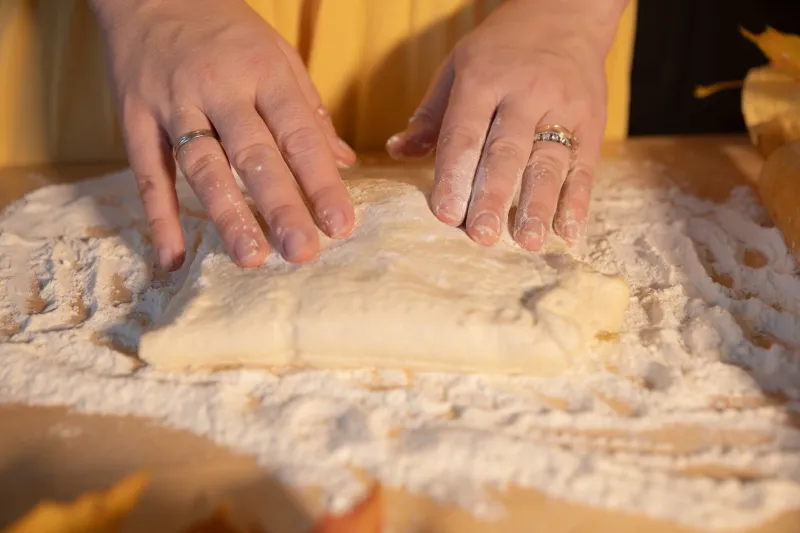
Here's the thing about bread baking specifically: it's rhythmic. Push, fold, turn. Push, fold, turn. That repetition isn't just satisfying in a tactile way—it actually does something to your brain.
Repetitive, focused physical tasks are known to activate the parasympathetic nervous system, the branch responsible for the "rest and digest" state most of us spend far too little time in. The same quality of attention that makes meditation effective—present, non-judgmental, anchored in physical sensation—gets recruited naturally when you're working dough with your hands.
You're not trying to be mindful. You just are, because the task demands it. The dough tells you when it needs more flour. Your palms tell you when the texture is shifting from sticky to smooth. You're reading feedback in real time, through touch, and that keeps your attention exactly where it needs to be: here, now, this.
For people who struggle with formal meditation—and that's most of us—bread baking offers a side door into the same mental state. No app required. No timer. Just your hands and something alive and responsive under them.
The Aroma Does Half the Work
Something happens about forty minutes into the bake. The cottage fills with that smell. You know the one—warm, yeasty, deeply familiar in a way that bypasses intellect and goes straight to something older. It's the kind of scent that makes your shoulders drop without you deciding to let them.
Smell is the only sense with a direct line to the limbic system, the brain's emotional core. It bypasses the prefrontal cortex—the part that overthinks, plans, and worries—and lands immediately in the parts of your brain associated with memory, emotion, and safety. The aroma of baking bread is one of the most universally comforting scents humans experience. It signals home, warmth, enough.
During a cottage retreat, that signal becomes especially potent. You made this. The cottage held you while you made it. Your body registers that combination and files it somewhere important.
The Patience Practice Nobody Talks About
Bread has its own timeline, and it will not be rushed. The yeast activates when it's ready. The dough rises on its own schedule. You can hover, but hovering doesn't help. At some point, you have to step away and let the process do what it does.
For high-achievers, planners, and people who live by productivity apps—which is to say, most American vacationers—this enforced waiting is quietly revolutionary. You set the dough to rise and then you have to do something that isn't controlling the outcome. Maybe you sit with a cup of coffee and watch the light move across the cottage floor. Maybe you read something for pleasure, not information. Maybe you just sit.
That waiting period is part of the therapy. Learning to trust a process that doesn't need your intervention is a skill that transfers. Not just to other recipes, but to relationships, to work, to life in general. A single morning of bread baking can plant that seed in a way that no podcast or self-help book quite manages, because you learned it through your body, not your brain.
Bringing the Practice Home
One of the most common things guests describe after a cottage stay is the desire to carry something back—not just a memory, but a practice. Bread baking is one of the most portable rituals there is.
You don't need a fancy kitchen or a lot of equipment. A basic no-knead loaf requires nothing more than a bowl, a Dutch oven, and a few hours. The barrier to entry is low enough that the habit can actually stick, unlike, say, resolving to meditate every morning or committing to a new fitness routine.
When you bake bread at home after a cottage retreat, the sensory memory kicks in. The smell of the dough, the feel of the flour, the quiet rhythm of the process—they all carry a trace of that cottage morning. Your nervous system recognizes the cue. It starts to settle before you've even consciously decided to relax.
That's not magic. That's conditioning. And the cottage is where the conditioning begins.
A Different Kind of Souvenir
We tend to think of vacation souvenirs as things we bring back in our bags—a candle, a piece of local art, a bottle of something interesting. But the most valuable souvenirs are the ones that live in the body: the way you learned to breathe more slowly, the morning rhythm you discovered, the proof that you can, in fact, be still.
Baking a loaf of bread at Four Winds Holiday Cottage is a small act with an outsized return. It asks almost nothing of you—a little time, a little patience, a willingness to get your hands dirty. In exchange, it offers presence, calm, and a skill you'll carry home long after the flour has washed off.
The kitchen is waiting. The dough is simpler than you think. And the reset you came here looking for might be one warm loaf away.